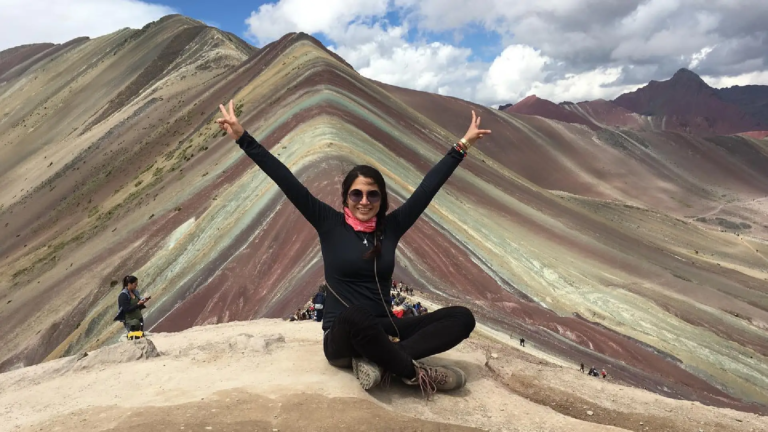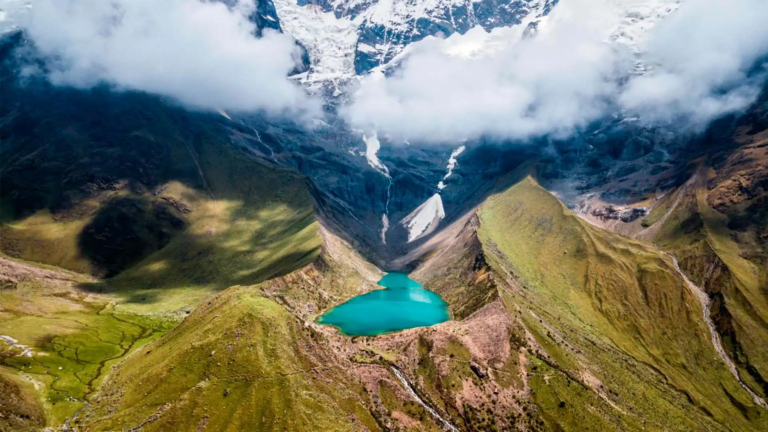

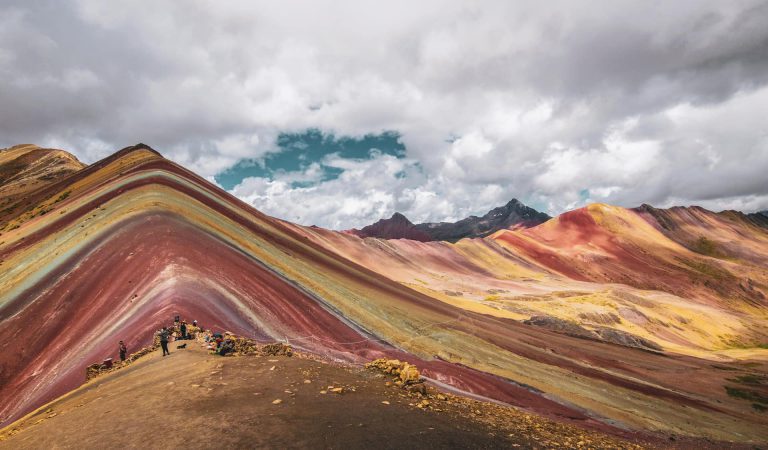
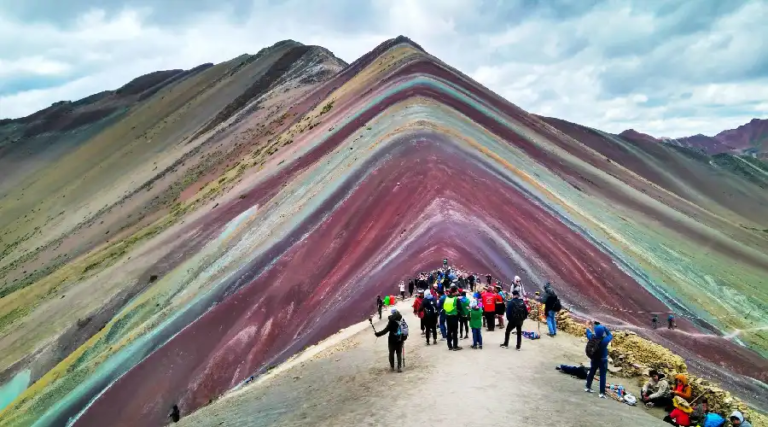
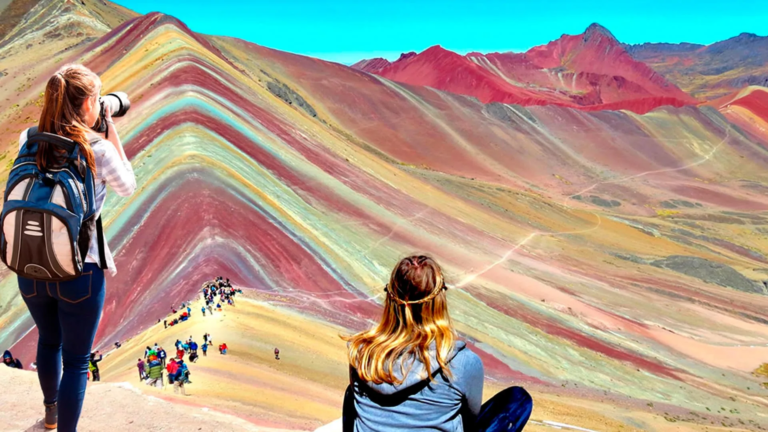
Rainbow Mountain, also known as Vinicunca or the Mountain of Seven Colors, represents one of the most extraordinary and visually striking geological phenomena in Peru. Located in the Vilcanota Range, about 100 kilometers southeast of Cusco and near the imposing Ausangate Glacier, this mountainous formation has captured worldwide attention due to its stunning palette of colors that decorates its slopes in perfectly defined horizontal bands.At 5,200 meters above sea level, this geological gem remained relatively unknown to international tourism until just over a decade ago, when the retreat of Andean glaciers due to climate change fully revealed its extraordinary polychromy. Today, it has become one of the most photographed and sought-after destinations for travelers from all over the world.In this guide, we will explore in depth the surprising geological formations that created this petrified rainbow in the Andean heights—a fascinating testimony to millions of years of geological activity.
Learn more →
Origin and Composition of Rainbow Mountain
Rainbow Mountain is the result of complex geological processes that have developed over millions of years. Its formation dates back to the Tertiary Period (30–35 million years ago), when the tectonic movements that gave rise to the Andes also caused the accumulation and compression of various marine sedimentary layers.
The key processes involved in its formation include:
- Marine sedimentation: Much of the material composing the mountain comes from ancient sea beds uplifted by Andean orogeny.
- Tectonic folding: The pressure from tectonic plate movement compressed these sediments, creating visible folds and strata.
- Varied mineralization: During this process, various minerals were deposited in distinct layers, each with a unique chemical composition.
- Glacial erosion: Finally, the erosive effect of glaciers and weathering exposed the internal layers, revealing the extraordinary polychromy.
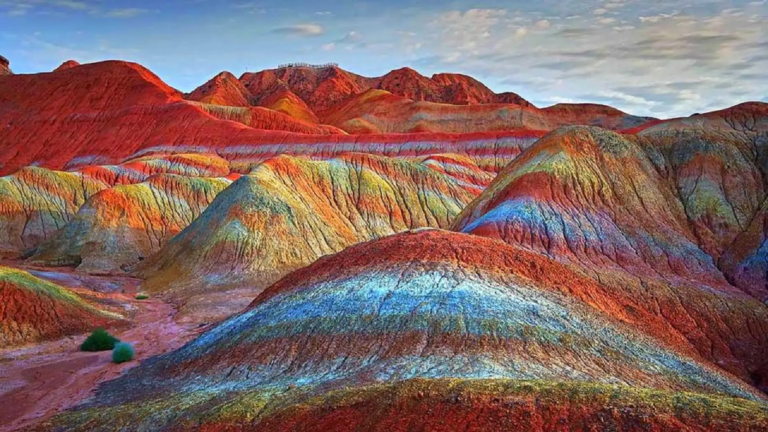
Unlike other colorful geological formations around the world, such as the Zhangye Danxia Mountains in China, Vinicunca features a unique combination of sedimentary and volcanic-origin minerals, explaining its singular color palette.
Strata and Minerals: The Secret Behind the Seven Colors
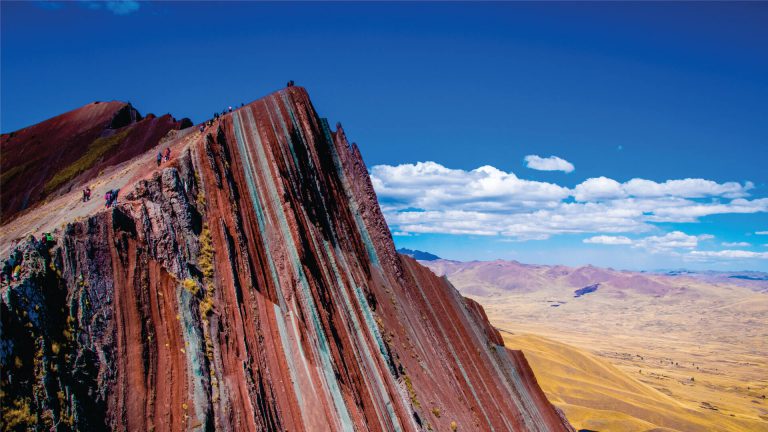
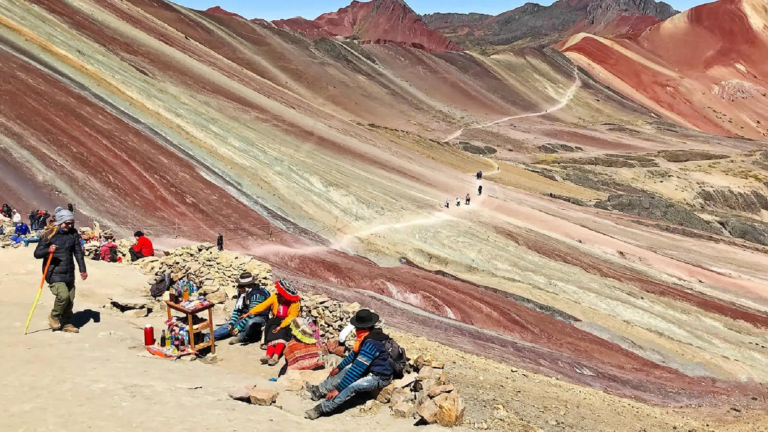
The most impressive feature of Rainbow Mountain is undoubtedly the clear differentiation of its color bands. Each hue corresponds to a specific type of mineral and geological composition:
- Intense red and purple: From clay rich in iron oxide (hematite). These reddish layers are often the most visible and photogenic, especially at sunrise.
- Golden yellow and ochre: Resulting from the presence of iron sulfides, limonite, and hydrated iron oxides in various concentrations.
- Green: Originates from chlorite compounds and ferrous oxide, indicating sediments rich in magnesium and iron in a reduced state.
- Blue and turquoise: Formed by copper sulfate compounds and minerals like azurite in low concentrations.
- Brown and beige: Reflects the presence of sandstone with high magnesium content and fanglomerates (sedimentary rock composed of angular fragments).
- Lavender and mauve: Contains traces of calcium carbonate mixed with special clays.
- Pink and whitish: Layers rich in limestone, gypsum, and quartz in varying concentrations.
These layers are not just surface-level but make up the internal structure of the entire mountain, as seen in areas where erosion has exposed cross-sections of the mountain.

Geological Uniqueness of Vinicunca
What makes Rainbow Mountain an extraordinary geological phenomenon goes beyond its visual beauty. Several scientific aspects make it a site of special interest for geologists and researchers:
- Perfect horizontal stratification: The arrangement of the layers in almost perfectly horizontal and well-defined bands shows an extraordinarily regular sedimentation process over millions of years.
- Intact preservation: Despite being in a seismically active region, the layers have maintained their structural integrity, suggesting unusual stability in the specific area of Vinicunca.
- Unique mineral gradient: The precise sequence of minerals seen in Vinicunca does not occur with the same clarity and extent in any other known formation on the planet.
- Paleoclimatic record: The different layers record climatic and environmental changes from various geological epochs, providing valuable insights into the Andean region’s climatic history.
Recent geological studies have revealed that some layers contain microfossils and traces of ancient marine life, confirming the oceanic origin of part of the sediments that compose the mountain—long before the Andes rose to their current height.
Conservation Status and Threats
Rainbow Mountain faces significant challenges for its long-term preservation. As a relatively fragile geological formation, its integrity is threatened by various factors:
- Accelerated erosion: The constant foot traffic of visitors has contributed to speeding up natural erosion processes, especially on access routes and the summit.
- Climate change: Increased heavy rainfall and the accelerated freeze-thaw cycle are affecting the stability of the mineral layers.
- Informal mining: In nearby areas, irregular mineral exploration and extraction threaten the geological balance of the entire region.
- Tourist pressure: The exponential increase in visitors (from fewer than 1,000 in 2016 to over 1,500 daily during peak season) is creating impacts that require urgent management measures.
Local and national authorities have begun implementing protective measures such as marking official trails, limiting the number of daily visitors, and launching environmental education programs for guides and tourists. However, conservation experts warn that more comprehensive and science-based plans are needed to ensure the preservation of this geological wonder.
Other Nearby Geological Formations
Rainbow Mountain is part of a larger geological complex that includes other equally fascinating formations within the Ausangate circuit:
- Red Mountain (Red Valley): Located close to Vinicunca, it features an extraordinary concentration of iron oxides that color the entire formation in deep crimson and vermilion hues.
- Pallay Punchu: Known as the “Mountain of 14 Colors”, it is a lesser-known formation that many geologists consider even more impressive than Vinicunca due to its variety of hues.
- Yanacocha formations: Rock structures around this “black lagoon” display unusual mineralization patterns with high graphite and carbon content.
- Three Canyons of Suykutambo: Although farther away, these canyons feature formations similar to Vinicunca but with vertical erosion patterns that create spectacular multicolored walls.
These formations share a geological origin with Vinicunca, but each presents unique mineral compositions. Together, they form a natural museum of Andean geological processes spanning millions of years of Earth’s history.
Conclusion
The geological formations of Rainbow Mountain are among the most extraordinary and visually impactful examples of the Andes’ mineral richness and complex geological history. Its unique color palette is not only a tourist attraction but also an open book where scientists can read millions of years of Earth’s transformations.
Understanding the processes that gave rise to these formations helps us better appreciate the temporal scale of our planet and the slow pace of major geological changes. Each stripe of color in Vinicunca represents thousands or millions of years of slow mineral accumulation, compression, and chemical transformation.
In a world that values immediacy, contemplating these mountains is a chance to connect with the deepest rhythms of the Earth and recognize that some of nature’s most beautiful works require not only immense physical forces, but also the most precious ingredient: geological time.
[tours_carrusel]


 Recogida: Desde su hotel en Cusco.
 Tour Valle Sagrado: Visita a Chinchero, Maras, Moray y Ollantaytambo (06:20 AM – 4:30 PM).
 Viaje en tren: De Ollantaytambo a Aguas Calientes (Duración: 2 horas).
 Noche de alojamiento: En Aguas Calientes (Machu Picchu). Descubre lo mejor del […]


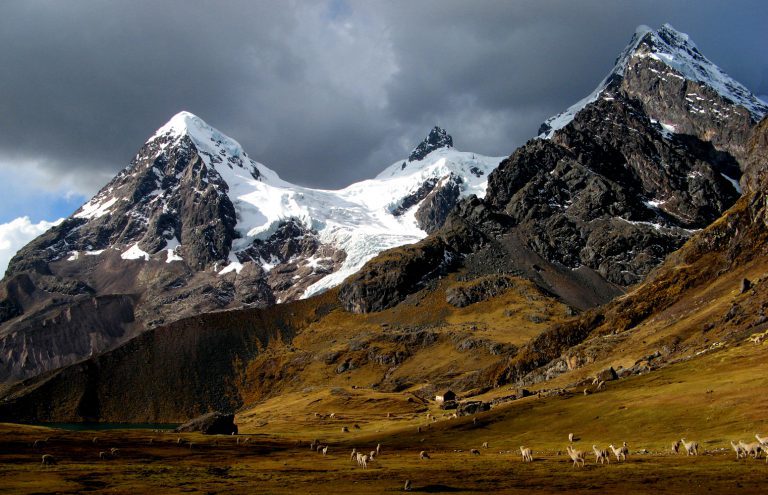


![Machupicchuhahatrips - Nevado Ausangate: Guía Completa del Trekking Sagrado y Montaña de 7 Colores [2025]](https://hahatrips.com/wp-content/uploads/2025/05/nevado-ausugante-768x432.webp)
![Machupicchuhahatrips - Montaña Roja Perú: Guía Completa del Trekking a Vinicunca [2025]](https://hahatrips.com/wp-content/uploads/2025/05/montana-roja-768x432.webp)