






Andean Rituals at Humantay Lake: Connecting with the Sacred Apus
The majestic Humantay Lake, located at 4,200 meters above sea level in the Peruvian Andes, is one of the most sacred places for Andean spirituality. Its turquoise waters, watched over by the mighty Apu Salkantay, have been the stage for ancestral rituals and ceremonies that are still practiced today.
In this sacred space, Andean rituals are not mere folkloric displays, but living expressions of a worldview that understands nature as a conscious being with which humans build reciprocal and respectful relationships. Every ritual performed here is a dialogue between the human world and the spiritual forces that inhabit the mountains, waters, and earth.
This guide explores the main Andean rituals practiced at Humantay Lake, their deep meanings, the elements involved, and how to participate respectfully in these ancient traditions. learn more ->
Apachetas: Stone Messengers to the Apus
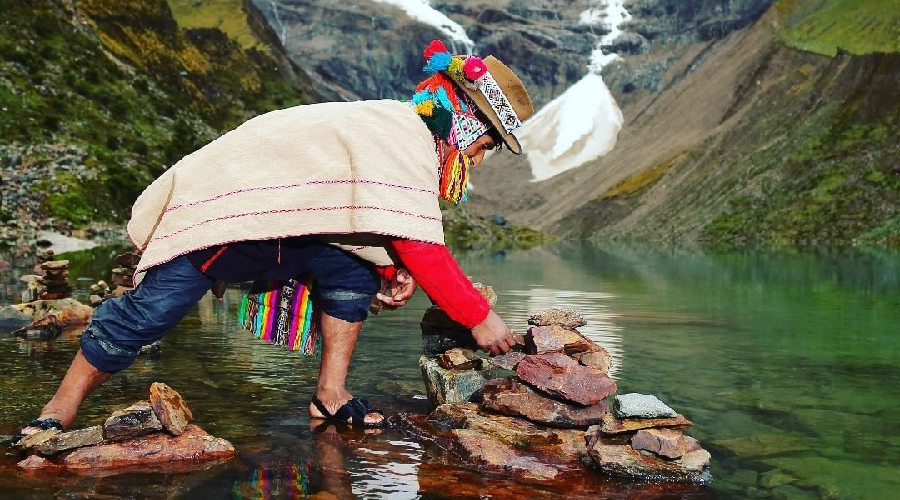
Among the most visible and accessible rituals for visitors to Humantay Lake is the construction and veneration of apachetas. These carefully stacked stone mounds serve as communication bridges between the earthly world and the Andean deities.
The apacheta ritual includes:
- Conscious selection: Find a stone along the path that «calls» to the pilgrim, establishing a personal energy connection.
- Samay or vital breath: Before placing the stone, it is gently blown on to transfer the pilgrim’s breath and intentions.
- K’intu offering: Three perfect coca leaves are placed under the stone as an offering to Pachamama and the Apus.
- Ritual placement: The stone is placed with the right hand, accompanied by a silent prayer or a request for protection.
- Circumambulation: Traditionally, the participant circles the apacheta three times counterclockwise to seal the ritual.
Each stone represents gratitude and the symbolic release of the traveler’s fatigue in exchange for the strength and protection of the sacred mountains. Apachetas act as direct communication stations with Apu Salkantay, one of the most revered mountain deities in the Andean pantheon.
Offerings to Pachamama
Pachamama (Mother Earth) is a central presence in Andean cosmology, and rituals to honor her are especially meaningful in high-energy places like Humantay Lake.
The despacho or payment to the earth is one of the most complete ceremonies performed here:
- Despacho preparation: On a ritual cloth or paper, various symbolic items are carefully arranged: coca leaves, seeds, grains, flowers, sweets, incense, colorful yarns, miniatures of animals, medicinal plants, and more representing the wishes and gratitude of the participant.
- Invocation: The ceremony begins with invocations to the four cardinal points, the surrounding Apus, and Pachamama, calling for their presence and blessing.
- Sharing coca: Participants chew coca leaves together in an act of communion with nature.
- Libation or ch’alla: Chicha (fermented corn drink) or alcohol is sprinkled on the earth as a liquid offering.
- Offering delivery: The offering is ritually wrapped and either burned or buried near the lake, completing the offering to Pachamama.
This ritual is often performed on specific dates such as August 1st (Pachamama’s month), solstices, or before important activities like a trek to Apu Salkantay.

Coca Leaf Ritual
The coca leaf (mama coca) is sacred in the Andes, and its ritual use at Humantay Lake goes beyond its medicinal purpose against altitude sickness.
The k’intu coca leaf ritual is essential for connecting with the deities of Humantay:
- K’intu selection: Three perfect coca leaves are chosen to represent the three Andean worlds: Hanan Pacha (upper world), Kay Pacha (present world), and Ukhu Pacha (underworld).
- Leaf reading: Local shamans or paqos interpret the selected leaves’ shapes, colors, and arrangement to receive messages from the Apus.
- Coca offering: The k’intu is gently blown on while silently making a wish or giving thanks, then placed under a stone, in the lake, or buried as an offering.
- Akulliku: Chewing coca leaves collectively is a moment of communion that precedes any significant activity at the lake.
Coca leaves act as intermediaries between humans and Andean deities, and their presence is essential in all rituals around Humantay Lake.
Ceremonies with the Apus
Apus are mountain deities that rule the Andean landscape, with Apu Salkantay being one of the most powerful and revered in the Humantay region.
Ceremonies to communicate with the Apus include:
- Phuska or calling: At sunrise or sunset, ritual specialists use conch shells (pututus) or traditional flutes to call the Apus with specific sounds.
- Ceremonial altar: A ritual «mesa» is laid out facing Apu Salkantay, with sacred items like power stones (khuyas), quartz crystals, totem animal figures, and medicinal plants.
- Direct communication: Yachaks or altomisayoqs (high-ranking Andean priests) enter special states of consciousness to connect with the spirit of the mountain and transmit its messages.
- Propitiatory dances: Traditional dances performed with symbolic costumes and movements to honor the Apu and request protection.
Due to its location and energetic qualities, Humantay Lake is considered a natural mirror that amplifies communication with Apu Salkantay, making it a privileged site for these ceremonies.
Solstice Celebrations
Solstices mark key moments in the Andean ritual calendar, and Humantay Lake becomes the stage for important ceremonies during these times.
The Inti Raymi or Sun Festival (winter solstice, June 21st) is celebrated with:
- Ritual bath: At dawn, some participants immerse in the lake’s cold waters for purification and to receive renewed solar energy.
- Solar offering: Offerings include golden items, yellow corn, and solar-colored flowers to honor Inti (the Sun god).
- First ray reception: The first sunbeam touching the lake is awaited to absorb its powerful energy.
During Capac Raymi (summer solstice, December 21st), the ceremonies focus on:
- Energy renewal: Cleansing rituals using lake water mixed with flowers and herbs.
- New cycle predictions: Ritual experts interpret cosmic and natural elements to predict the year ahead.
- Thanksgiving dances: Choreographed expressions of gratitude for past harvests and blessings for the coming cycle.
The specific orientation of Humantay Lake to the sun’s movements adds special meaning, as light effects on the water are seen as divine manifestations.
Tips for Respectful Participation
For visitors who wish to participate or witness Andean rituals at Humantay Lake, it’s essential to do so with deep respect and awareness:
- Ask for permission: Always request permission before taking photos or joining a ritual.
- Observe silently: Maintain respectful silence and distance during ceremonies.
- Only join if invited: Do not participate unless explicitly invited by locals.
- Avoid superficial appropriation: Don’t perform “tourist versions” of rituals without proper knowledge or guidance.
- Prepare adequately: Follow any instructions regarding fasting or spiritual readiness before participating.
- Offer sincerely: Make offerings from a place of genuine respect and gratitude, not performance.
- Understand the context: Educate yourself beforehand to understand the rituals’ spiritual depth.
Trusted local guides can provide authentic experiences of these sacred practices while respecting ancestral traditions.
Conclusion
The Andean rituals practiced at Humantay Lake reflect the living continuity of a spiritual tradition that has endured and adapted over centuries. Beyond anthropological or touristic value, these practices represent a complex system of relationship with nature that offers vital lessons on reciprocity, respect, and balance.
Participating reverently in these cultural expressions during your visit to Humantay allows for a deeper travel experience, transforming a scenic trip into a meaningful encounter with a spirituality that sees humans as part of nature—not its masters.
The turquoise waters, the towering Apu Salkantay, and the apachetas marking the path remain witnesses to these ancient dialogues between the human and the divine, inviting us to reconnect with a worldview that may hold healing insights for our modern relationship with the natural world.