




History and Origin of Q’ero Textiles
The Q’ero textile tradition has roots extending back to the pre-Inca horizon, though it reached its peak refinement and complexity during the height of the Inca Empire, of which the Q’ero are considered direct descendants. According to oral history and anthropological studies, after the Spanish conquest and the fall of Cusco, a group of Inca tradition keepers took refuge in the remote and nearly inaccessible mountains they now inhabit.
Key moments in Q’ero textile history:
- Pre-Inca period (before 1200 AD): Development of basic weaving techniques and early natural dyes extracted from local plants and minerals.
- Inca imperial era (1438–1533): Refinement of techniques and consolidation of the backstrap loom. Textiles gained ceremonial and social importance.
- Isolation period (1533–1955): The Q’ero retreated to remote areas, preserving their textile traditions with almost no external influence for over 400 years.
- Rediscovery (1955): Anthropologist Oscar Núñez del Prado’s expedition “discovered” the Q’ero communities for the modern world, revealing their extraordinary textile tradition.
- Contemporary era: Revitalization of ancestral techniques and adaptation to new contexts, while maintaining the symbolic and spiritual essence of the textiles.
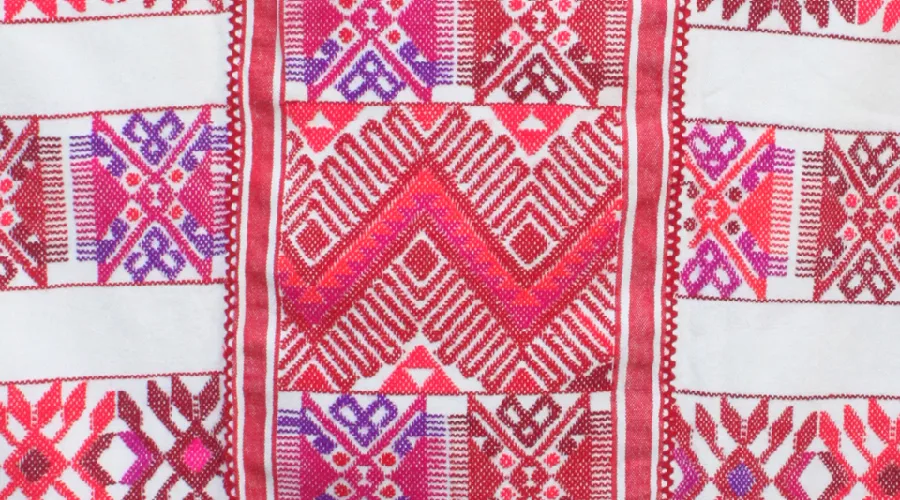
What’s most notable about this tradition is that, unlike many other Andean cultural expressions, Q’ero textiles have maintained extraordinary technical and symbolic continuity over the centuries. The *pallay* (designs) woven today by Q’ero women use the same patterns and techniques as their Inca ancestors, representing one of the purest examples of cultural continuity in the Andes.
Techniques and Materials of Q’ero Textiles
The extraordinary quality of Q’ero textiles stems from both their technical sophistication and the careful selection and preparation of materials, many of which come from the same natural environment surrounding Rainbow Mountain.
Main Materials:
- Alpaca fiber: The main base of Q’ero weavings, highly valued for its fineness, durability, and heat retention. Mostly sourced from alpacas raised by the communities themselves.
- Sheep wool: Introduced after the conquest, used for certain garments and as a complement to alpaca fiber.
- Wild fibers: Occasionally, fibers from vicuña (for the most sacred garments) and local plants like maguey are used.
Natural Dyes:
The Q’ero master the art of natural dyeing, extracting vibrant, long-lasting colors from:
- Cochineal: A parasitic insect on the prickly pear cactus that produces intense reds and magentas.
- Ch’illca: An Andean shrub that yields green tones.
- Q’olle: A mountain plant that produces bright yellows and ochres.
- Minerals: Extracted from surrounding mountains, including Rainbow Mountain, to obtain blues, earthy reds, and oranges.
- Qaqma: An Andean lichen that gives grayish-green and olive tones.
- Molle: A tree whose leaves and fruits produce shades of green and gray.
Weaving Techniques:
Among the sophisticated techniques used are:
- Awapa: Belt weaving with a high thread count that allows for intricate designs.
- Ley pallay: «Picked weaving» technique creating three-dimensional and textured patterns.
- K’uthu: A complex complementary warp technique that produces precise geometric designs.
- Watay: Similar to ikat, where threads are tied before dyeing to create resist patterns.
Creating a high-quality Q’ero textile can take between one and three months of continuous work, from fiber selection and preparation to the final finishes. These techniques are passed down from mothers to daughters starting at an early age, typically around 5–6 years old, when girls begin by observing and practicing on smaller looms.
Symbolism and Meaning of Q’ero Textiles
What truly sets Q’ero textiles apart is their elaborate symbolic system, which transforms each garment into a visual text that tells stories, transmits knowledge, and connects with spiritual dimensions. These textiles act as true “textile books” that convey complex information about cosmology, sacred geography, agricultural cycles, and social relations.
Main Symbolic Elements:
- Ch’uncho pallay: Design representing jungle communities, symbolizing exchange and complementarity between ecological zones.
- Inti (Sun): Depicted as a diamond with interior dots, symbolizing masculine energy and solar divinity.
- Killa (Moon): Circles or crescents representing feminine energy and temporal cycles.
- T’ika (Flower): Stylized floral patterns symbolizing fertility and abundance.
- Chakana (Andean cross): Central symbol representing the connection between the upper, earthly, and underworld realms.
- Qhawaq Ñan: Serpentine lines symbolizing sacred paths and energetic lines (ceques) connecting sacred sites.
Sacred Geography in the Textiles:
A fascinating feature of Q’ero textiles is their capacity to map the sacred territory they inhabit. The designs often include representations of:
- Apu Ausangate: The most important sacred mountain, represented as a large triangle or stepped zigzag.
- Rainbow Mountain: Appears as horizontal bands of overlapping colors, replicating the mineral strata of the real mountain.
- Sacred lagoons: Concentric circles or spirals representing bodies of water considered portals to other dimensions.
- Paqarinas: Mythical places of origin symbolized with specific community-based designs.
Each Q’ero textile also conveys information about the wearer’s identity: their community of origin, marital status, social role, and even family connections. These «identity garments» are especially important during ceremonies and rituals held at sacred sites around Ausangate and Rainbow Mountain.
Connection with Rainbow Mountain
The relationship between Q’ero textiles and Rainbow Mountain (Vinicunca) is profound and multidimensional, encompassing practical, aesthetic, and spiritual aspects that reflect this people’s intimate bond with their sacred territory.
Chromatic Inspiration:
The color palette of Q’ero textiles is directly inspired by the mineral strata of Rainbow Mountain and the surrounding landscape:
- Deep reds evoke layers of iron oxide (hematite).
- Yellows and ochres replicate sulfides and hydrated iron oxides.
- Greens represent chlorite compounds and ferrous oxide.
- Blues and turquoises emulate copper sulfates and minerals like azurite.
- Browns and earth tones reflect fanglomerate and sandstone layers.
Source of Materials:
The area around Rainbow Mountain provides many materials used in weaving:
- Dye minerals: Q’ero communities carry out expeditions to collect soils and minerals from different zones of the mountain to create dyes.
- Dye plants: Many plants used for natural dyes grow in specific microclimates around the mountain.
- Ceremonial water: Water from certain springs and lagoons near Rainbow Mountain is used in ceremonial dyeing processes.
Spiritual Dimension:
For the Q’ero, weaving is a sacred act that recreates their connection with the land:
- Before beginning an important textile, weavers make offerings (despachos) to Apu Ausangate and Rainbow Mountain.
- Certain ceremonial textiles can only be woven in specific locations with a view of the mountain.
- During festivals such as Qoyllur Rit’i, textiles serve as «antennas» connecting participants to the sacred mountain energies.
- Designs representing Rainbow Mountain have protective properties and are considered portals to spiritual dimensions.
In Q’ero cosmology, there’s a parallel between weaving and the formation of mountains: both represent the creation of order from chaos. Just as Pachamama “wove” the layers of Rainbow Mountain over millions of years, Q’ero weavers recreate this divine act every time they produce a new textile—continuing the cycle of cosmic creation.
Where to Buy Authentic Q’ero Textiles
Purchasing authentic Q’ero textiles is a meaningful way to support the preservation of this ancestral tradition and directly contribute to the communities’ economy. However, it is essential to do so responsibly and ethically, ensuring that artisans receive fair compensation for their extraordinary work.
Where to Buy Authentic Textiles:
- Directly in communities: During treks along the Ausangate and Rainbow Mountain route, it’s possible to visit Q’ero communities like Hatun Q’ero, Q’ero Totorani, and Japu, where weavers sell their creations directly without intermediaries.
- Specialized fairs in Cusco: Events like the Traditional Textile Fair of San Blas and the Q’ero Producers Artisan Market (held quarterly) offer authentic pieces and direct contact with artisans.
- Certified cultural centers: The Center for Traditional Textiles of Cusco (CTTC) and Awamaki Association work directly with Q’ero communities and guarantee authenticity and fair trade.
- Weavers’ cooperatives: Organizations like Ñawpa Away («Weaving the Past») and Q’ente Textile Revitalization Society are managed by the communities themselves and offer their products at permanent locations in Cusco.
How to Recognize Authentic Q’ero Textiles:
To distinguish genuine Q’ero textiles from industrial imitations:
- Natural irregularities: Authentic textiles show slight variations and «imperfections» indicative of handmade creation.
- Weaving density: Genuine Q’ero weavings have an extraordinary thread density (up to 120 threads per square inch).
- Design complexity: Traditional patterns are incredibly detailed and have specific meanings that can be identified.
- Deep but not artificial colors: Natural dyes yield earthy, rich, subtly variable tones—very different from the uniform, bright hues of synthetic dyes.
- Documentation: Authentic textiles often come with information about the weaver, the community, and the meanings behind the designs.
It’s important to understand that high-quality Q’ero textiles are priced in accordance with the extraordinary labor and time invested. A small item like a *chullo* (traditional hat) may require a full week of work, while a *lliclla* (ceremonial mantle) can take up to three months.
When you buy these textiles, you’re not just purchasing souvenirs—you’re acquiring unique pieces of living cultural heritage that support the preservation of ancestral knowledge and directly empower the communities keeping this extraordinary tradition alive.
Conclusion
Q’ero textiles are much more than artisanal expressions—they are living repositories of ancestral knowledge, storytellers of millennia-old histories, and tangible bridges between the past and present of Andean culture. Their deep connection with the sacred landscape of Rainbow Mountain and Ausangate makes them material expressions of a worldview that sees humans as integral parts of nature.
In a world where cultural homogenization is advancing rapidly, these textile traditions offer valuable lessons on sustainability, intergenerational knowledge transmission, and the ability of art to encode and preserve complex information. Each Q’ero garment is simultaneously a historical document, a work of art, a map of sacred territory, and an expression of cultural identity.
For travelers visiting the Rainbow Mountain region, respectfully engaging with the Q’ero textile tradition offers a deeper understanding of the land and its people. These weavings remind us that the true wonders of the Andes are not found only in the physical landscapes, but also in the extraordinary cultural expressions inspired by them over the centuries.
[tours_carrusel]