Chinchero: Cradle of the Rainbow in the Sacred Valley
Chinchero is one of the most evocative places in the Sacred Valley of the Incas. Set on a high plateau overlooking the Urubamba Valley, it effortlessly combines monumental Inca-era terraces, a colonial church with white walls and red tile roofs built on stone foundations, and a weaving tradition that comes alive on every loom. For travelers seeking living history, wide-open landscapes and genuine contact with local communities, Chinchero is a must-stop.
Known as the “Cradle of the Rainbow”, Chinchero offers, especially at sunrise and sunset, a crystal-clear light that sets ablaze the colors of the textiles, the fields and the snowcapped mountains on the horizon. Its appeal isn’t limited to the archaeological site: the traditional weekend market, the textile interpretation centers and the hospitality of its people turn a visit into a well-rounded experience. In heritage terms, the site sums up the encounter (sometimes harmonious, sometimes tense) between imperial Inca architecture and the colonial legacy, visible in the imposing Church of Our Lady of Montserrat and the Cusco School paintings it holds inside.
In this guide you’ll find everything you need to plan your trip to Chinchero: how to get there and when to go, the historical background of the site, the keys to its architecture and agricultural engineering, its cultural and spiritual importance for local communities, and practical tips to make the most of your time responsibly and safely.
Cusco City Tour →
Where Is Chinchero and How Do You Get There?
Chinchero is located about 28–30 km (17–19 miles) northwest of the city of Cusco, in the province of Urubamba, at more than 3,700 m (12,100 ft) above sea level. Its position on a broad plateau offers superb views of the snowcapped peaks and the farming valleys, and makes it an excellent base for reaching other destinations in the Sacred Valley.
- From Cusco: The drive takes 45 to 60 minutes, depending on traffic and photo stops at viewpoints. You can get there on a tour, by taxi or in a private vehicle.
- From Urubamba or Yucay: The distance is short and the trip is quick. Many travelers stay overnight in the valley and visit Chinchero on the way to Maras, Moray or Ollantaytambo.
- Public transportation: There are shared vans (colectivos) from Cusco (from the Santiago or Puputi areas, depending on availability). Once in Chinchero, the archaeological site is a short walk from the town center.
Best time to visit: From April to October, clear skies and ideal light for photography are the norm; from November to March the countryside turns a vivid green, with occasional rain that brings dramatic clouds. In any season, bring warm layers: the wind in Chinchero can be cold even when the sun is out.
History of Chinchero
Human settlement in Chinchero dates back to pre-Inca times, but it reached its greatest development during the Tahuantinsuyo. Tradition credits Túpac Inca Yupanqui with building a royal palace or estate on this plateau, chosen for its mild climate, farming potential and views. Like other royal estates in the valley, Chinchero brought together residential, ritual and productive spaces, along with water infrastructure and an extensive network of terraces.
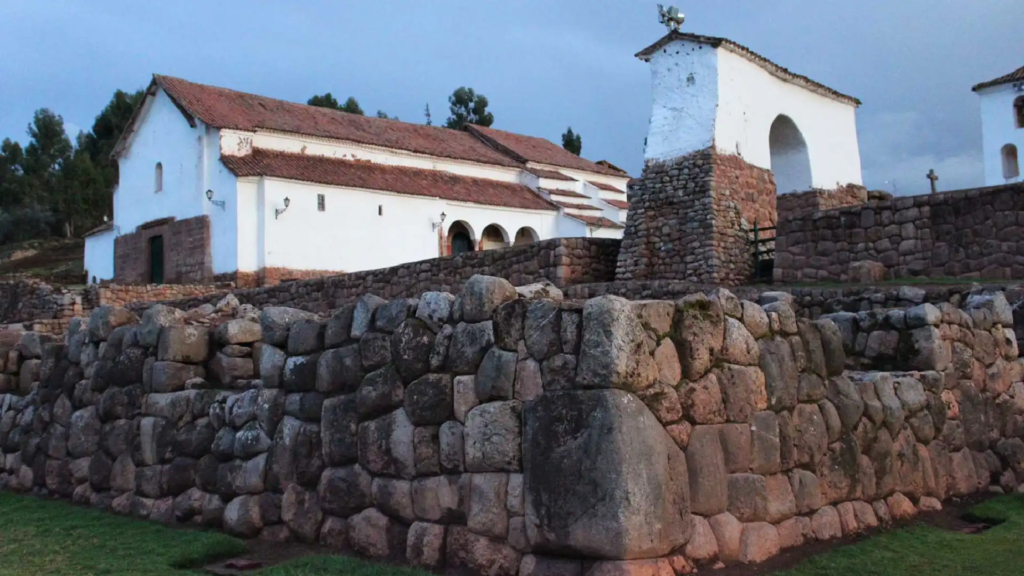
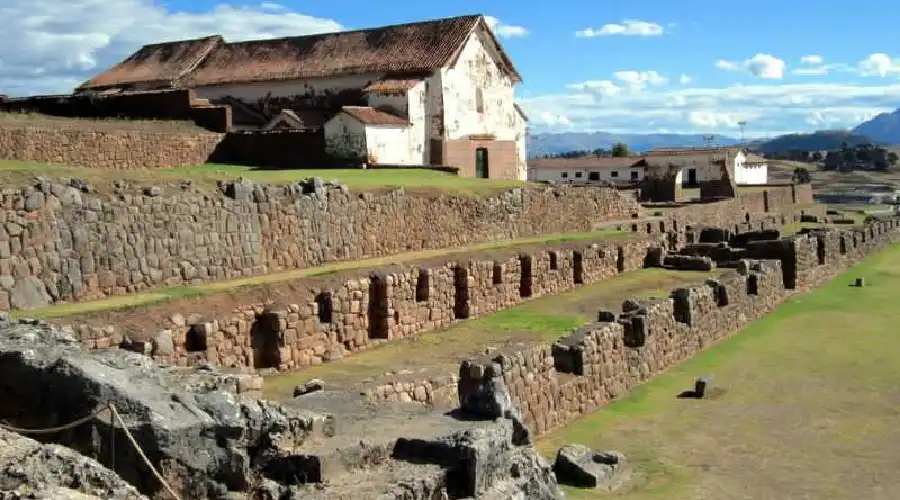
After the Spanish conquest, the stone foundations served as the base for colonial buildings, above all the Church of Our Lady of Montserrat, whose Baroque nave preserves Cusco School paintings, carvings and polychrome work. This layering of eras is the site’s most striking feature: walking through Chinchero means moving between perfectly fitted Inca walls and colonial lime-and-stone facades, under the same Andean horizon.
Economically and culturally, Chinchero kept its farming and herding roots and also became a regional trading hub. The Sunday market and, above all, its weaving tradition (which survives to this day) shaped its identity. This continuity of knowledge, passed down through families and ayllus (Andean kinship communities), explains why the name Chinchero is synonymous with high-quality textiles, natural dyes and symbolic designs that tell the stories of the land.
Architecture and Agricultural Engineering
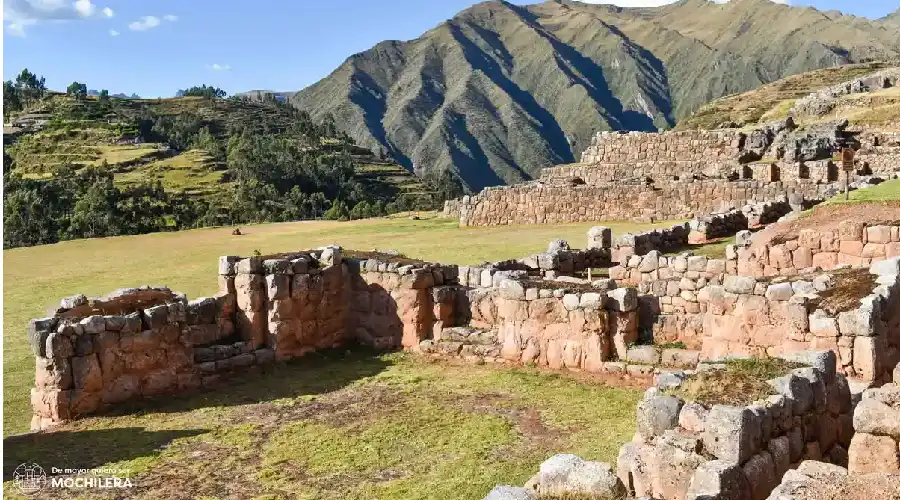
The architectural complex of Chinchero combines Inca, colonial and vernacular structures. In the sections built on Inca foundations you can see finely worked stone walls with almost invisible joints, trapezoidal niches, double-jamb doorways and stairways connecting the different levels of the terrain. On top of these foundations, colonial builders raised chapels, atriums and courtyards, creating a unique dialogue of styles.
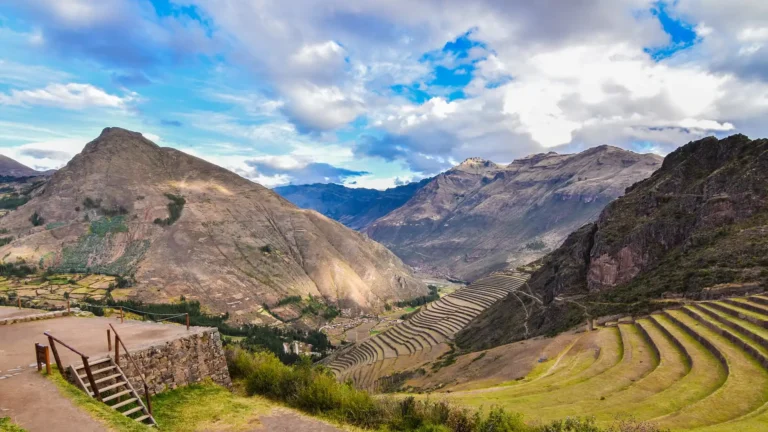
- Monumental terraces: They surround the ceremonial and residential core. They served many purposes: farming, soil stabilization, water control and, just as importantly, an aesthetic vision that gives the landscape of Chinchero its identity.
- Hydraulic engineering: Channels, drains and springs (ojos de agua) cross the terrain to carry and filter water. This control prevented erosion and kept the soil at the moisture levels needed for crops.
- Church of Montserrat: Built in the 17th century on an Inca platform. Inside, religious paintings and floral motifs stand out, along with a coffered ceiling that bears witness to Andean artistic syncretism.
- Plaza and atrium: Community gathering spaces where patron saint festivals, markets and rituals take place. From here you get some of the best panoramic views of the archaeological area.
- Traditional houses and textile centers: Adobe and tile-roofed houses, along with family workshops open to visitors, complete the town with dyeing, spinning and backstrap loom weaving.
The result is a cultural landscape where every element speaks to the others. In Chinchero, stone, water and weaving are not separate pieces: together they form a social technology that organizes the land, passes on identity and creates beauty.
Cultural and Spiritual Importance
In the Andean world, farming, weaving and spirituality are deeply intertwined. Chinchero embodies this union: the terraces sustain material life; the threads, dyed with cochineal, k’olle or molle, carry the community’s memory; and the church, built over a sacred Inca space, expresses a ritual continuity, mestizo today, that draws people to devotion and celebration.
Chinchero‘s textile designs (diamonds, crosses, stepped frets, animal figures) are not decoration: they are a language that refers to the apus (mountain spirits), to waterways and to trade routes. In each workshop, master weavers explain how the wool is selected, spun and dyed with local plants and minerals, keeping alive a chain of knowledge that has stood the test of time. Joining a demonstration doesn’t just enrich your visit: it supports family incomes and helps preserve ancestral techniques.
Throughout its festival calendar, Chinchero celebrates patron saint days, harvests and pilgrimages that bring together music, dance and food. This ritual life, visible in the atrium and the streets, gives the place an energy that goes beyond admiring ruins: it invites you to engage respectfully with the daily life of a community that sees itself as heir to the Incas.
The Visitor Experience
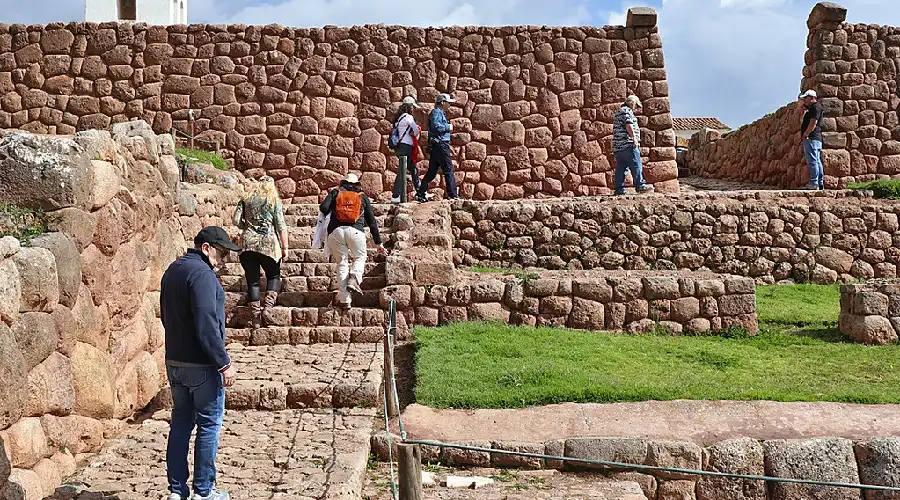
Exploring Chinchero means combining heritage, landscape and learning. You can visit on your own or with a guide, and the visit almost always includes the archaeological site, the church and a textile center. If you have more time, add short walks along the terraces or trails that connect with nearby communities.
- Archaeological circuit and plaza: Walk the upper platform, the stairways and the Inca walls, before or after going into the church (check opening hours). From the plaza, the views of the snowcapped peaks are unforgettable.
- Textile interpretation center: Watch the entire process: washing and spinning the wool, preparing natural dyes, warping and weaving on a backstrap loom. It’s the perfect moment to photograph Chinchero as a living town.
- Market and food: On weekends you’ll find stalls with textiles, ceramics and carved gourds and, at lunchtime, chupe (hearty soup), chicharrón (fried pork) or local breads. Shop thoughtfully and value handmade work.
- Viewpoints and walks: Short trails let you walk down to the terrace levels or along their edges for sweeping views of the whole site.
Useful facts:
- Altitude: ~3,700 m (12,100 ft) above sea level. Acclimatize in Cusco or the valley before longer hikes.
- Recommended time: 2–4 hours for a full visit; half a day if you add textile demonstrations and a photo session.
- Best light: Clear mornings and late afternoon. The walls and rooftops take on golden tones that bring out the character of Chinchero.
Tips for Your Visit
- Tourist Ticket: Admission to Chinchero is included in the Cusco Tourist Ticket (Boleto Turístico, partial or full version). Check which circuit best fits your Sacred Valley itinerary.
- Clothing and gear: Sneakers with good traction, a cap or hat, sunscreen, UV sunglasses and a windbreaker. The weather is changeable and it’s often windy.
- Water and food: Bring a reusable water bottle and light snacks. Avoid heavy meals before climbing up and down stairways.
- Respect the heritage: Don’t climb on the walls, follow the signs and don’t fly drones without a permit. Conservation depends on every visitor.
- Shop responsibly: Choose workshops and cooperatives that are open about their processes and pay fair prices. Ask about the natural dyes used in Chinchero‘s textiles.
- Mindful photography: Ask permission before photographing people, especially artisans who are weaving or dyeing.
- Weather and season: From April to October the skies are more stable; from November to March the landscape is green with rain. Bring a light rain jacket in the wet season.
- Suggested itineraries:
- Half day: Archaeological site + church + textile center.
- Full day in the Sacred Valley: Chinchero early + Maras and Moray + viewpoints.
- With family: Hands-on textile demonstration + stroll around the plaza and atrium.
Conclusion
Chinchero brings together, in a single place, Inca building genius, the colonial artistic legacy and the vitality of a weaving tradition that keeps weaving community together. With its privileged location, its terraces tracing the outline of the plateau and its plaza that draws people together for celebration and trade, it is a place where the past is not a ruin: it is a present renewed every day.
If you’re looking for a destination that combines history, landscape and living culture, include Chinchero on your Sacred Valley route. Arrive with time to spare, chat with the master weavers, take in the church at sunset and let the high-altitude wind quietly tell you why this town is the true Cradle of the Rainbow.